ArtLab Satbayev University
 ArtLab Satbayev University emerged as a response to the internal demand of a technical university for new forms of creative thinking, communication, and educational experience. ArtLab Satbayev University creates a space where engineering education organically integrates with creative and humanitarian practices, fostering a community oriented towards sustainable development. Students participate in theatrical performances, artistic interventions, and interdisciplinary projects, developing creative thinking, communication, and teamwork skills.
Theater
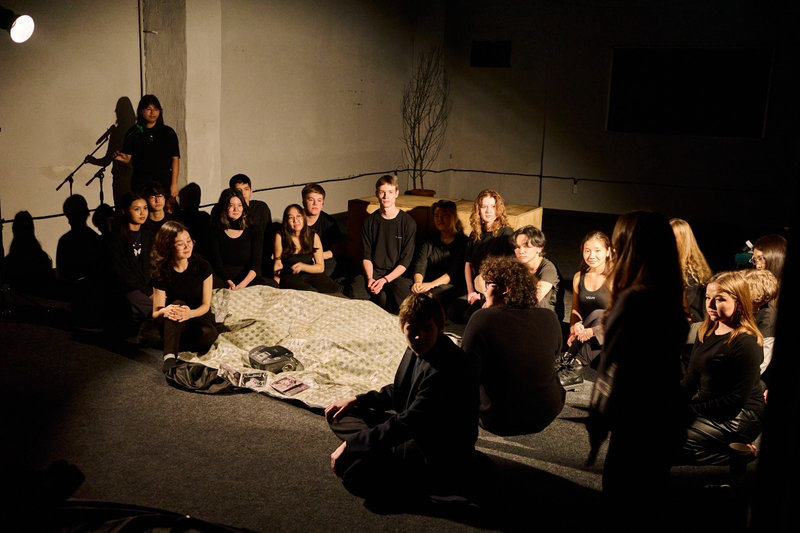
In ArtLab, theater functions as an educational and research practice aimed at developing creative thinking, communication, reflection, and teamwork. It is used as a tool for working with behavior and decision-making in conditions of uncertainty.
The laboratory implements three interconnected levels:
- student theater — a full-cycle practice of creating a performance (from idea to public presentation), forming project work and teamwork skills;
- staff theater — a space of interdisciplinary interaction that develops a culture of trust and horizontal connections within the university;
- professional theater — projects involving practicing actors and directors, integrating students into the industry and bringing results to city and festival venues.
This structure makes it possible to connect education, practice, and the professional environment of creative industries.
Cycle of creative disciplines
The Cycle of creative disciplines of ArtLab is an interdisciplinary educational model based on the philosophy of Bildung and aimed at the formation of a holistic engineer.
At the center of learning is the development of the ability to consider social and cultural context, work with uncertainty, and build meaningful communication.
Students are offered a choice of one of five disciplines:
- acting and communication
- directing and project thinking
- fundamentals of design and fashion
- scenography
- creative entrepreneurship
The learning process is structured in two stages:
- Semester 1 — formation of basic competencies and development of an individual educational trajectory;
- Semester 2 — advanced practical work and participation in interdisciplinary team projects.
Project work and final presentation
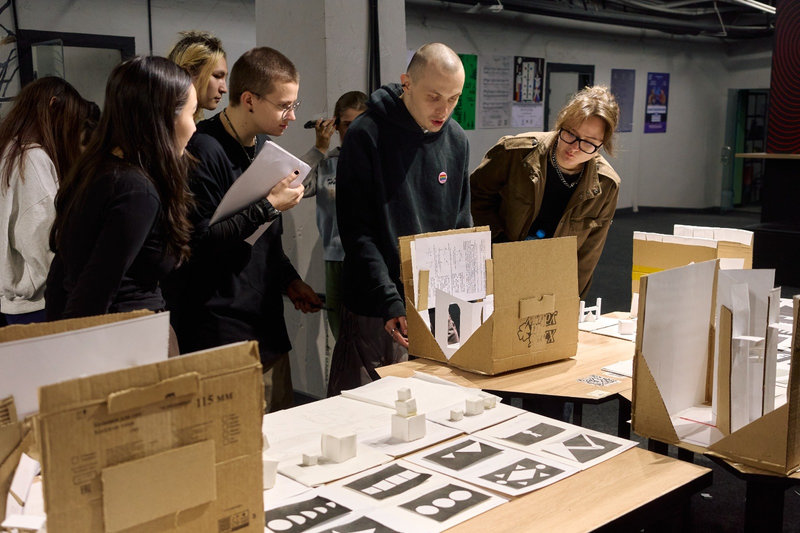
Project activity begins with the formation of a “problem cloud” — a map of topics reflecting real student needs and experiences. This approach allows a transition from abstract learning to working with relevant social and cultural challenges.
Within the first cycle, 100 students were involved in project work, forming 10 interdisciplinary projects aimed at exploring themes of gender equality, ecology, communication, and the future.
The final format is a public presentation of projects — the “Super Exam,” within which students present results in the form of performances, films, design solutions, and social projects. This format makes it possible to assess not only knowledge but also the ability to integrate it, work in teams, and communicate with a wide audience.
ArtLab’s activities are aligned with the United Nations Sustainable Development Goals, including SDG 4 (Quality Education), SDG 5 (Gender Equality), SDG 10 (Reduced Inequalities), SDG 11 (Sustainable Cities and Communities), and SDG 12 (Responsible Consumption). The educational and project practices of ArtLab are aimed at developing interdisciplinary thinking, critical reflection, and social responsibility. Through engagement with relevant themes — gender equality, ecology, communication, and the future — students develop experience in creating solutions oriented toward people, society, and the principles of sustainable development.
From the very beginning, ArtLab was conceived not merely as a creative space, but as an environment where humanitarian, artistic, and creative practices could be seamlessly integrated into engineering education, expanding and complementing it. The laboratory provides a safe and inspiring environment for experimentation and knowledge exchange, contributing to the development of a new generation of specialists capable of creating innovative solutions for a sustainable and socially responsible future.
In 2023, ArtLab began its activities with theater as the primary form of engagement with the university audience. The concept and launch of the space were developed by Anel Syzdykova-Bitossi, a graduate of the University of Florence UNIFI. At this stage, theater was considered an ideal tool for thinking, reflection, and communication within a technical university. During the year, the first theater troupe was formed from students of different courses and specialties, and just three months after the opening, ArtLab presented its first independent work — the premiere of the play Mechanism (December 19, 2023).
The year 2024 began with the production of the play Happiness at Polytech, created by director Dmitry Kurochkin, a graduate of the MXAT School-Studio. Later, the play was staged at the city theater ARTISHOK, where engineering students for the first time performed on a professional theater stage and presented their work to the city audience. At the same time, university staff began training in acting at ArtLab. The result of this work was the premiere of the play Choristers, created by the university team. In the autumn, ArtLab reached a new level of tasks related to educational integration. The festival Where to Land? became a symbolic moment of rethinking the role of creative practices within the university environment.
In 2025, the Offstage project was launched — a series of meetings with theater professionals dedicated to the backstage side of theatrical professions. In parallel, the concept of the Creative Disciplines Cycle, based on the philosophy of Bildung, was being developed.
Thus, ArtLab has established itself as an educational platform and a center for creative industries, shaping a new type of engineer — a specialist with developed humanitarian thinking, creativity, and social responsibility. ArtLab projects demonstrate the potential impact of university initiatives on the development of the country’s creative industries and the training of personnel capable of working at the intersection of technology, culture, and society. The laboratory’s projects contribute to the development of a sustainable community, the integration of technology and culture, the support of innovation, and the preparation of specialists ready to create solutions for a socially and environmentally responsible future. Their activities directly contribute to achieving the United Nations Sustainable Development Goals, including SDG 4 (Quality Education), SDG 9 (Industry, Innovation and Infrastructure), and SDG 11 (Sustainable Cities and Communities).