SDG 14. Life Below Water
Satbayev University contributes to achieving SDG 14 through research and projects aimed at protecting aquatic ecosystems, reducing pollution, and providing scientific support for sustainable management of water territories. The university participates in the Aral geo-park initiative, supports research on the purification of natural and reused waters, including the removal of microplastics and organic pollutants, and develops partnerships to study environmental issues of the Caspian Sea. This approach allows Satbayev University to contribute to the conservation of vulnerable aquatic ecosystems in Kazakhstan and the region.
What does this mean for Satbayev University
The university uses its competencies in hydrogeology, geoecology, and environmental monitoring to support the conservation of aquatic ecosystems and sustainable water resource management.
Sustainable environment
One of the strongest examples is the university's participation in the Aral geo-park initiative, which Satbayev University presents as a scientific and international platform for the sustainable future of the Aral Sea region. The university shows that research, education, local communities, and partnerships come together around this topic, meaning that the contribution to SDG 14 is also realized through creating an environment where the conservation of vulnerable aquatic ecosystems becomes part of the institutional agenda.
An important part of the sustainable environment is also the development of applied solutions for water purification and reuse. The university has presented projects on water purification and desalination, as well as on creating composite materials for water treatment. This demonstrates that the university is building not only academic interest in water issues but also a practical environment where technologies that can reduce pollution and support a more sustainable state of aquatic ecosystems are developed.
Research
Satbayev University contributes to achieving SDG 14 "Life Below Water" through research aimed at protecting aquatic ecosystems, reducing water pollution, and providing scientific support for sustainable management of vulnerable water territories. Although the university is not a specialized maritime institution, its strong scientific competencies in hydrogeology, geoecology, water technologies, and environmental monitoring allow it to participate in solving challenges related to life below water. This is confirmed both by the university's educational and research directions and by its project and partnership activities.
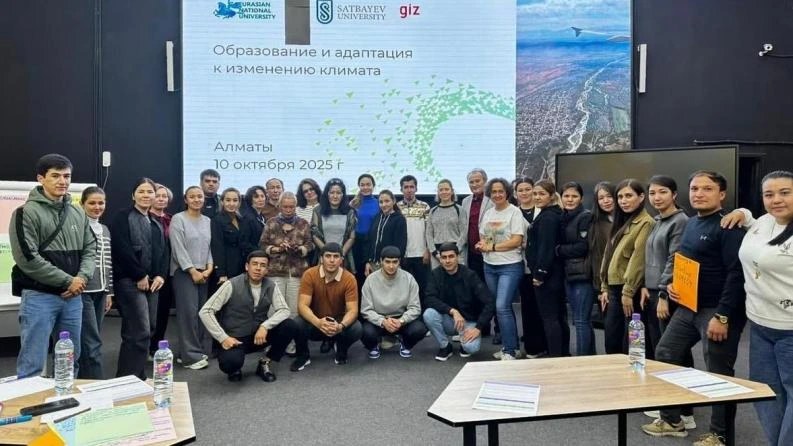
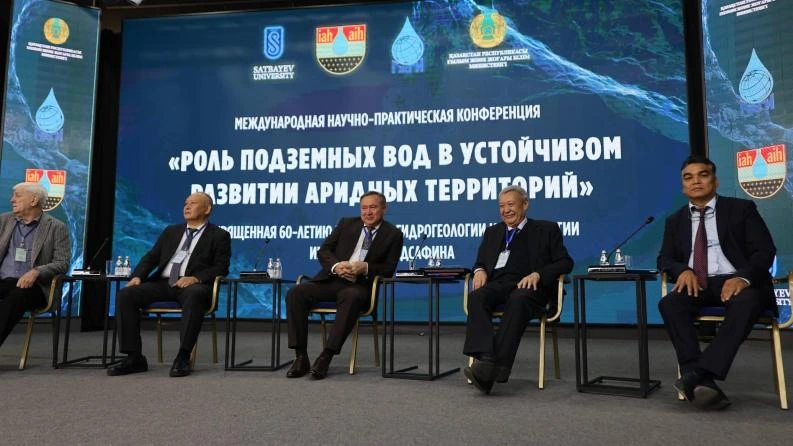
In 2025, the university hosted an international seminar on climate-induced water risks, where droughts, floods, heatwaves, transboundary water risks, and solutions for sustainable regional development were discussed. Although this is broader than just marine topics, such research and expert discussions are directly related to the sustainability of aquatic ecosystems and how climate change affects inland water bodies and coastal territories of Central Asia.
Education
The university offers programs in water resources, hydrogeology, ecology, and water diplomacy. The university's program list includes Water Resources and Water Use, Water Diplomacy, Hydrogeology and Engineering Geology, as well as Environmental Sciences, forming an academic base for training specialists in sustainable water environment management.
A particularly strong direction for SDG 14 is the Water Diplomacy program, which trains specialists to understand the political nature of water resources, manage water-related tensions, and find ways to cooperate. This is important for the university because the sustainability of aquatic ecosystems depends not only on technology but also on the ability to manage water conflicts, transboundary water systems, and long-term environmental risks.